From Over Thinking to Inner Calm Flow

From Overthinking to Inner Calm: Understanding Anxiety
Through the Lens of IFS
by Kellee Thomson
There is a particular kind of exhaustion that comes from living inside a mind that never seems to switch off.
Replaying conversations.Planning for every possible outcome.Wondering whether you said the wrong thing.Trying to keep everyone happy.Setting incredibly high standards for yourself.Preparing for problems that haven't happened yet.
Sometimes we call it anxiety.
Sometimes it looks more like perfectionism, people-pleasing, overworking, hypervigilance or a constant need to stay in control.
And often, underneath all of it, there may be parts of us working incredibly hard to keep us safe.
This is one of the things I love about Internal Family Systems (IFS).
Working with my clients, I gently guide them to more Self enquiry, more curiosity.
Rather than asking:
“How do I stop overthinking?”
IFS therapy invites us to become curious about a different question:
“What is the part of me that is overthinking trying to do for me?”
What if your anxiety isn't the enemy?
When anxiety becomes overwhelming, our natural instinct is often to want it gone.
We might try to distract ourselves, reason our way out of it, suppress our thoughts or tell ourselves to “just calm down.”
But anxious parts rarely respond well to being pushed away.
From an IFS perspective, anxiety can sometimes be understood as a protective response.
There may be a part constantly scanning the environment for danger.
Another part may replay conversations so we don't make the same mistake twice.
A perfectionist part might believe:
If I do everything perfectly, nobody can criticise me.
A people-pleasing part might carry the belief:
If everyone around me is happy, I'll be safe.
And an overthinking part may genuinely believe that if it considers every possible outcome, nothing will be able to catch us by surprise.
These patterns can become exhausting, but they often developed for a reason.

The perfectionist who never lets you rest
Perfectionism is something I often think about very differently through the lens of IFS.
On the surface, perfectionism can look like achievement, organisation and high standards. I resonate so deeply with this & I have beautiful "perfectionista" parts... like a whole tribe of them, that used to run the show of my inner world. Until i learned IFS & slowly learned how to Integrate these parts into trusting my higher self leadership.
Underneath, it can sometimes carry enormous pressure.
Don't make a mistake.
Try harder.
You should be doing more.
What will people think?
You can't let anyone down.
Rather than trying to eliminate this part, we can begin getting curious about it...
Gently go within and ask the part...
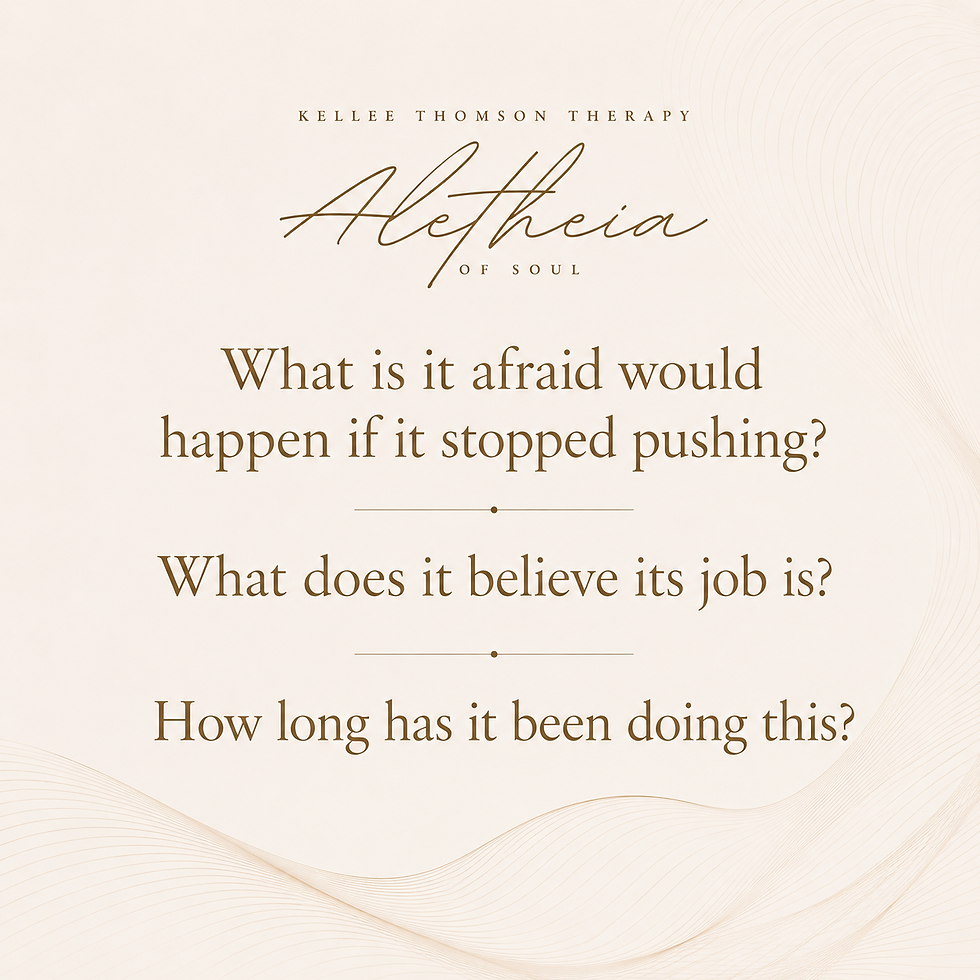
Often, when we approach our protective patterns with curiosity rather than criticism, something begins to soften.
The inner critic may be protecting something too
The inner critic can be one of the most difficult parts of our internal system to understand compassionately.
It can sound harsh.
It might tell us we're not good enough, attractive enough, successful enough, productive enough or capable enough.
But even the critic may have a protective intention.
Sometimes criticising ourselves first feels safer than being criticised by somebody else.
Sometimes the critic believes shame will motivate us to improve.
Sometimes it is desperately trying to protect more vulnerable feelings underneath — rejection, inadequacy, loneliness, fear or the possibility of not belonging.
IFS doesn't ask us to agree with everything the critic says.
It asks us to become curious about why it feels it needs to say it.
That is a very different relationship with ourselves.
When your nervous system is always preparing for something
Anxiety isn't experienced only in our thoughts.
It lives in the body too.
A racing heart.
Tight shoulders.
A clenched jaw.
Restlessness.
Difficulty sleeping.
A feeling that something is about to happen even when you can't quite explain what.
Our nervous system can become accustomed to anticipating threat.
So part of working with anxiety may involve recognising that we cannot always think ourselves into safety.

You are more than your anxious parts
One of the central ideas within IFS is that underneath our protective strategies, fears and wounds exists something referred to as Self.
Self isn't another part we need to create.
It is the presence within us capable of qualities such as curiosity, compassion, calm, clarity, courage and connectedness.
You may notice a glimpse of it when instead of saying:
“Why am I like this?”
you find yourself wondering:
“I wonder what this part of me needs?”
That small shift from judgement to curiosity can be profound.
The goal isn't to become a person who never feels anxious.
It is to develop a different relationship with anxiety.
One where the anxious parts of us no longer have to carry everything alone.
From overthinking to inner calm
Inner calm doesn't necessarily mean having a completely quiet mind.
It may look more like being able to notice an anxious thought without immediately being consumed by it.
Recognising the perfectionist without automatically obeying it.
Hearing the inner critic without believing every word.
Feeling anxiety arise and being able to gently turn toward yourself rather than away.
Perhaps the journey isn't:
“How do I get rid of this part of me?”
Perhaps it is:
“How can I understand this part of me?”
Because sometimes the parts making the most noise are the parts that have been working the hardest to protect us.
And sometimes they don't need to be silenced.
They need to know they are no longer alone.

From Overthinking to Inner Calm
I will be exploring these ideas more deeply in my upcoming
2-hour online IFS workshop:
From Overthinking to Inner Calm
An Introduction to Internal Family Systems (IFS)
A gentle and supportive space exploring anxiety, overthinking, perfectionism, the inner critic, people-pleasing, emotional overwhelm and nervous system regulation through the lens of IFS.
Check on the Events Page for the next event online, or near you for our in person workshops.
No previous experience with IFS is required.
Bookings: KelleeThomsonTherapy.com
Kellee Thomson Therapy Aletheia of Soul
Deep Gratitude for being here, Kellee Thomson

Comments